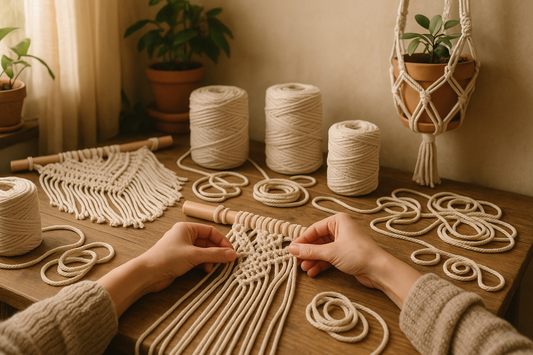
When I started in the wonderful world of macramé, I made many mistakes. The most common ones were when deciding what type of yarn to use for each project. With the art of macramé, you can create an infinite number of projects, some examples are handmade jewelry, handmade bags, home decor, keychains, handmade macramé clothing, among many other options. In this space, I will try to explain the types of yarns and what type of project they are most used for. Additionally, I want you to know that you should not limit yourself; a macramé knot is made with any type of yarn, and your imagination dictates your project. Also keep in mind that these yarns come in different thicknesses, and the terms are in millimeters, from the finest, 1mm, to the thickest, 9mm, it all depends on your creativity. Additionally, their material varies; in my projects, I almost always use 100% recycled cotton from brands like Ganxxet and Bobbiny. But you can find polyester, blended, and other types of yarns.
3-ply or twisted yarn
The first yarn I want to introduce you to is twisted or 3-ply. This yarn consists of three strands twisted together. It's perfect for decorative tapestries, plant hangers, keychains, among many others. Its texture is hard and resistant. This yarn is one of the most expensive due to its versatility.
Single strand yarn (combed/warp)
This yarn is extremely soft, and the knots have delicate details. I love using it for decorative tapestries and pieces that don't have much movement, as it tends to deteriorate faster. This yarn is available in a wide variety of colors.
Braided yarn
This yarn is the most used for bags, keychains, and pieces that have a lot of movement and use. Braided yarn has movement, meaning it is a bit elastic and should not be used for heavy pieces. This type of yarn is quite popular because it is very resistant. It is usually a blend of polyester and cotton. Some come with another strand in the center that serves as support, and others are hollow and are called "air braided."
As I tell my students, macramé can be done with any yarn you have on hand since the real technique is the knots you make. Start practicing with the yarn you have available and let your creativity flow. In my experience, I like to create with different textures and different types of yarn, but the one I use the most right now is combed or single strand. Little by little, I have discovered which one works best for each type of project, but it's all about preferences and tastes. Don't limit yourself.
I hope this has helped you a little, and if you have ideas for topics, write to me at sramacrame@gmail.com or on social media @sramacrame
With love,
Sra. Macramé - "Where knots become art"
Photo not mine, found on the internet